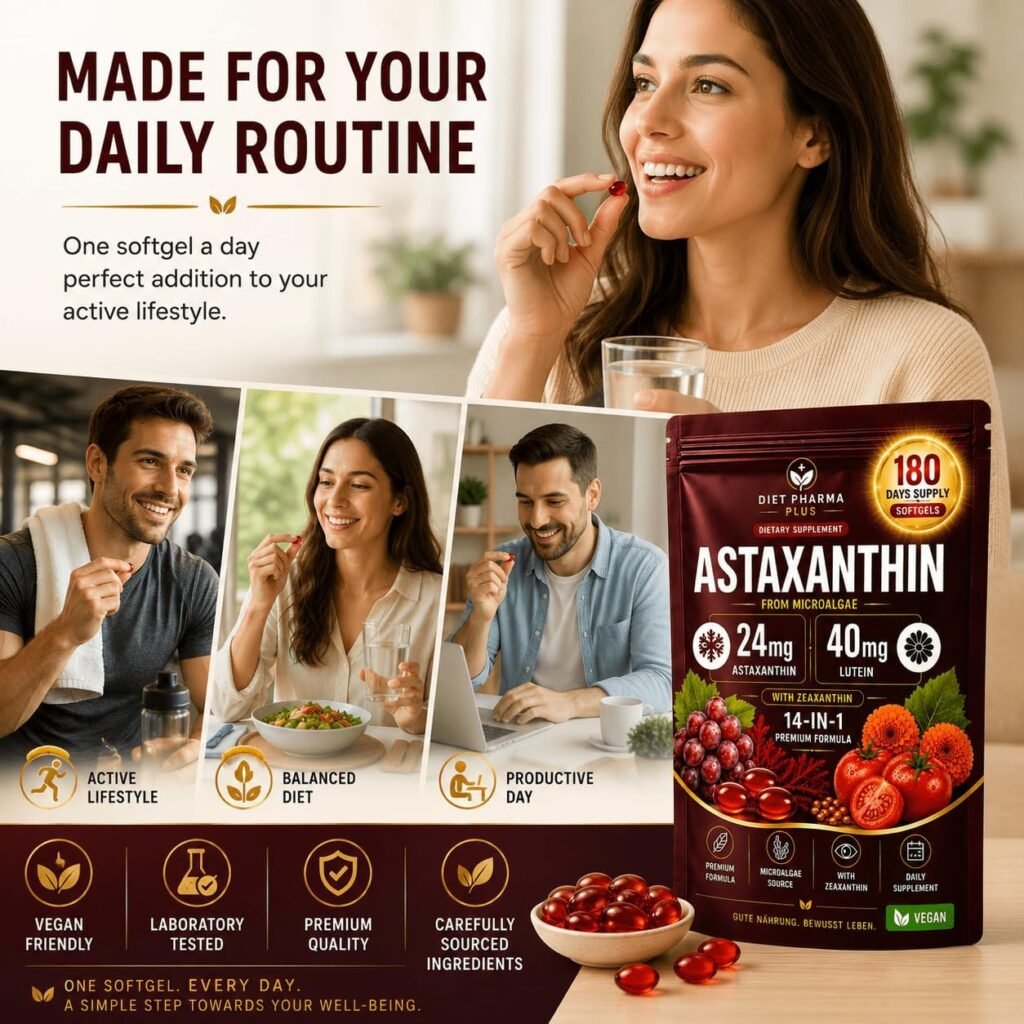
Astaxanthin from Haematococcus pluvialis: Complete Guide to the Diet Pharma Plus 14-in-1 Formula
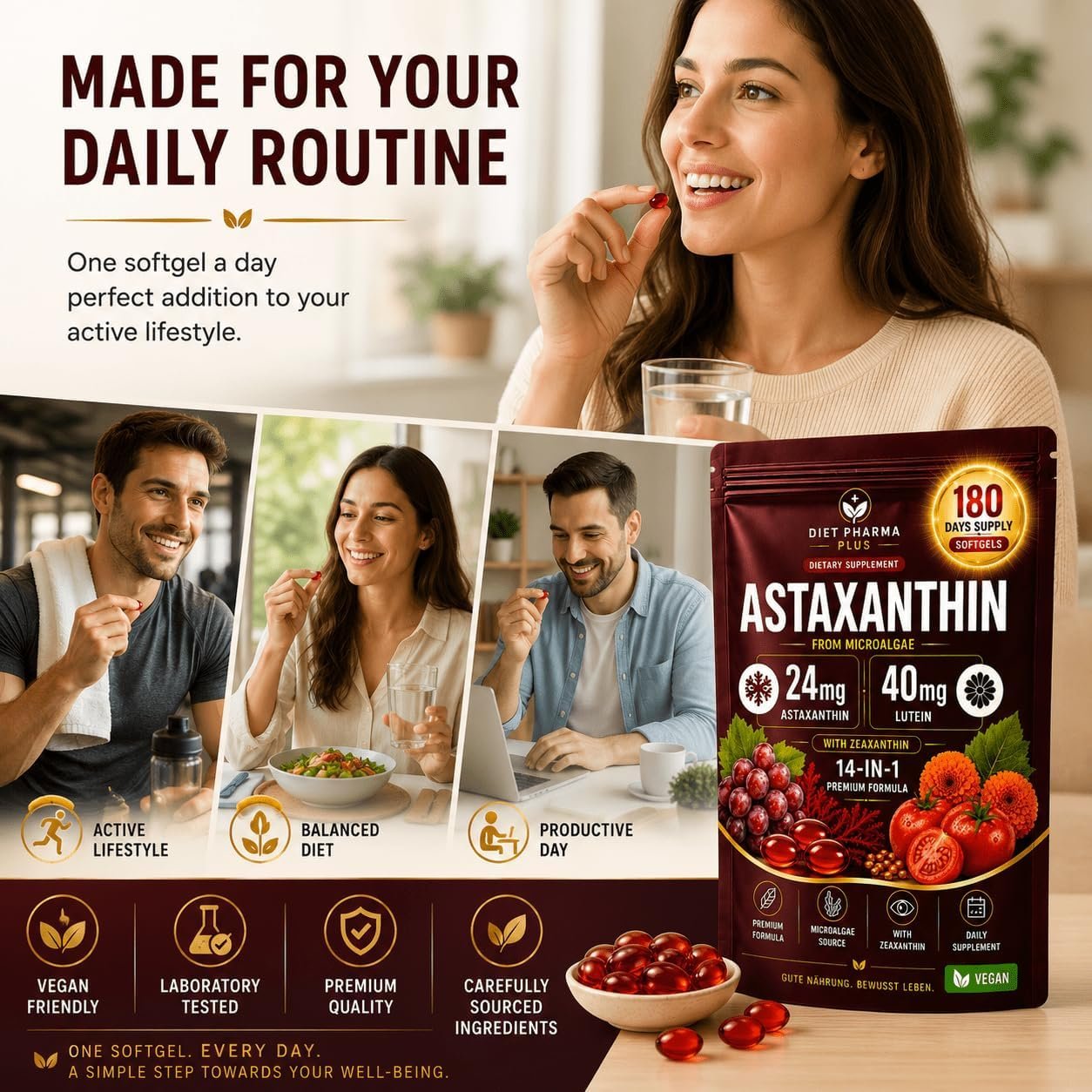
Astaxanthin from Haematococcus pluvialis: Inside Our 14-in-1 Softgel Formula
A detailed look at astaxanthin from microalgae, lutein, zeaxanthin, lycopene, grape seed extract, saffron, selected vitamins and minerals — and how these ingredients come together in the Diet Pharma Plus Astaxanthin Complex.
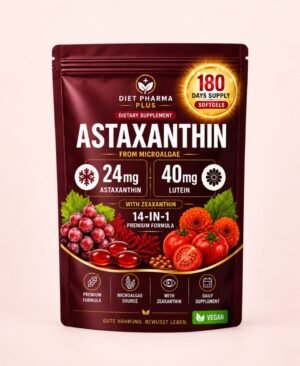
Astaxanthin is a naturally occurring carotenoid that can be obtained from the microalga Haematococcus pluvialis. Its deep red colour makes it visually distinctive within the carotenoid family, which also includes compounds such as lutein, zeaxanthin, lycopene and beta-carotene.
The Diet Pharma Plus Astaxanthin Complex has been developed as a multi-ingredient food supplement rather than a single-ingredient formula. It combines astaxanthin from Haematococcus pluvialis with selected carotenoids, plant-derived ingredients, vitamins, minerals and L-tyrosine in a convenient softgel format.
In this guide, we take a closer look at what each part of the formula is, where key ingredients come from, how to read an astaxanthin supplement label and what consumers should consider when comparing different astaxanthin products.
What Is Astaxanthin?
Astaxanthin belongs to the carotenoid family — a broad group of naturally occurring pigments found in plants, algae and other biological sources. Carotenoids are responsible for many of the yellow, orange and red colours seen in nature.
Astaxanthin is especially associated with the freshwater microalga Haematococcus pluvialis. Under particular environmental conditions, this microalga accumulates the characteristic red carotenoid.
For food supplements, the origin of the astaxanthin is an important point to check. A product description should clearly identify the source rather than simply displaying the word “astaxanthin” on the front of the packaging.
Five Carotenoids Within One Formula
The Diet Pharma Plus formula brings together several members of the carotenoid family in a single product.
Why Haematococcus pluvialis?
Haematococcus pluvialis is a microalga used as a source of naturally derived astaxanthin in food supplements. When comparing products, the declared source is useful because it provides more information than an isolated ingredient name.
A transparent astaxanthin product should make the source easy to identify on the packaging and in the product information. Diet Pharma Plus identifies the astaxanthin source as Haematococcus pluvialis microalgae.
More Than Astaxanthin: Understanding the 14-in-1 Formula
Rather than offering astaxanthin as a standalone ingredient, this Diet Pharma Plus product combines several ingredient groups. The formulation includes carotenoids, plant-derived extracts, vitamins, minerals and L-tyrosine.
This type of multi-ingredient formulation can be convenient for customers who prefer one combined product instead of several separate bottles. It also means that the complete ingredient declaration deserves careful attention.
Lutein, Zeaxanthin and Lycopene: Understanding the Carotenoid Blend
Astaxanthin is not the only carotenoid in the formula. Diet Pharma Plus combines it with lutein, zeaxanthin, lycopene and beta-carotene.
Lutein from Marigold Flower Extract
Lutein is a yellow-orange carotenoid. In this formula, the lutein is sourced from marigold flower extract. The product information lists 40 mg of lutein in the stated formula.*
Zeaxanthin
Zeaxanthin is another carotenoid included alongside lutein. Diet Pharma Plus lists 4 mg of zeaxanthin in the stated formula.*
Lycopene from Tomato Extract
Lycopene is the red carotenoid naturally associated with tomatoes and other red-coloured plant foods. The formula uses lycopene derived from tomato extract.
Beta-Carotene
Beta-carotene is another well-known member of the carotenoid family and forms part of the broader 14-ingredient composition.
Grape Seed Extract, Saffron and L-Tyrosine
The formula extends beyond carotenoids by adding selected plant-derived ingredients and L-tyrosine.
Grape Seed Extract
Grape seed extract is produced from grape seeds and can be standardised for specific naturally occurring plant compounds. When a standardisation such as an OPC percentage appears on a supplement, consumers should check that the declaration is supported by the specification of the finished product.
Saffron Extract
Saffron is obtained from Crocus sativus. Rather than using saffron simply as a culinary spice, supplement formulations can contain a concentrated saffron extract.
L-Tyrosine
L-tyrosine is an amino acid and represents a different ingredient class from the carotenoids, plant extracts, vitamins and minerals also present in the product.
Vitamins and Minerals in the Formula
Diet Pharma Plus Astaxanthin Complex also includes selected vitamins and minerals. These should always be considered when comparing the product with other supplements, particularly if several products are used as part of the same routine.
| Ingredient | Ingredient group | What to check on the final label |
|---|---|---|
| Vitamin E | Vitamin | Quantity per recommended daily serving and %NRV |
| Zinc | Mineral | Quantity and %NRV |
| Copper | Trace mineral | Quantity and %NRV |
| Selenium | Trace element | Quantity, unit and %NRV |
| Vitamin B6 | B vitamin | Quantity and %NRV |
| Vitamin B12 | B vitamin | Quantity, unit and %NRV |
Why the Softgel Format?
Softgels are soft, sealed capsules that commonly contain ingredients in a liquid or oil-based filling. They differ from conventional hard capsules, which often contain powders.
From a practical perspective, a softgel product requires no weighing, scooping or mixing. Customers should nevertheless check the complete softgel shell and carrier ingredients on the final product label, particularly where dietary preferences are important.
Storage instructions should also be followed carefully. Softgels can be sensitive to unsuitable heat and storage conditions, depending on their composition.
180 Softgels: Understanding Pack Size
The standard Diet Pharma Plus Astaxanthin Complex pack contains 180 softgels, with a larger 360-softgel option also available through the product listing.
Pack size and number of daily servings are not necessarily the same thing. The number of servings depends on the recommended daily intake stated on the final product label.
How to Compare Astaxanthin Supplements
Astaxanthin products can differ significantly in formulation. Some contain only astaxanthin, while others combine it with carotenoids, oils, plant extracts, vitamins or minerals.
A useful comparison therefore looks beyond one large number on the front of a pack.
- Check whether the astaxanthin source is clearly identified.
- Read the recommended daily serving on the final label.
- Check whether quantities refer to one softgel or the full daily serving.
- Review all additional carotenoids and plant extracts.
- Check vitamins and minerals for overlap with other supplements.
- Read the complete ingredient list, including the softgel shell and carrier ingredients.
- Review age restrictions and other mandatory label information.
- Follow the stated storage instructions.
What Does “14-in-1” Mean?
“14-in-1” describes the multi-ingredient nature of the formula. It does not mean fourteen separate products or fourteen medical effects.
In practical terms, it means that the formulation brings together astaxanthin, four additional carotenoids, selected plant ingredients, L-tyrosine, vitamins and minerals within one product.
This distinction is important because the number of ingredients alone should never be treated as a quality ranking. Consumers should instead consider the exact composition, transparent labelling and whether the product format matches their preferences.
Astaxanthin and EU Food-Supplement Labelling
Astaxanthin obtained from Haematococcus pluvialis for use in food supplements is subject to specific European conditions of use and labelling. For that reason, the final physical product label should always be treated as the authoritative source for the recommended daily intake, age information and mandatory warnings.
Customers should also avoid combining multiple astaxanthin supplements without first reviewing the relevant product labels. If there is uncertainty about whether a supplement is suitable in an individual situation, advice should be obtained from an appropriately qualified healthcare professional.
Who Should Pay Particular Attention to the Label?
Every customer should read the product information before use, but additional care is sensible where a person already uses several supplements, takes medication, is pregnant or breastfeeding, has a medical condition, or is buying a product for a child or adolescent.
These situations require individual consideration and cannot be addressed by a general product article.
How to Store Astaxanthin Softgels
Always follow the storage instructions printed on the final product packaging. As a general organisational principle, supplement packaging should remain properly closed and should not be exposed unnecessarily to unsuitable heat, moisture or direct sunlight.
Keeping the original packaging is useful because it preserves important information such as the product name, ingredients, recommended intake, batch details, minimum durability date and storage instructions.
Food supplements should always be stored out of reach of young children.
Diet Pharma Plus Astaxanthin Complex at a Glance
| Product type | Multi-ingredient food supplement |
|---|---|
| Main ingredient | Astaxanthin from Haematococcus pluvialis microalgae |
| Format | Softgels |
| Standard pack | 180 softgels |
| Additional pack option | 360 softgels |
| Formula | 14 selected ingredients |
| Key carotenoids | Astaxanthin, lutein, zeaxanthin, lycopene and beta-carotene |
| Plant-derived ingredients | Grape seed extract and saffron extract |
| Other selected ingredient | L-tyrosine |
| Vitamins | Vitamin E, Vitamin B6 and Vitamin B12 |
| Minerals | Zinc, Copper and Selenium |
Frequently Asked Questions
What is Astaxanthin?
Where does the Diet Pharma Plus astaxanthin come from?
Is this a single-ingredient astaxanthin product?
What is lutein in this formula?
Does the product contain zeaxanthin?
Does the product contain lycopene?
What does 14-in-1 mean?
How many softgels are in the pack?
How should I take the product?
Can I use it together with another astaxanthin supplement?
Is this article medical advice?
Explore Diet Pharma Plus Astaxanthin Complex
View the current product information, available pack sizes, ingredient details and purchasing options.
*Ingredient amounts shown in this article should be checked against the final approved product label before publication and updated whenever the marketed formulation changes.
Practical information about supplements, vitamins, gummies, capsules, softgels, ingredients, product labels and everyday supplement routines.